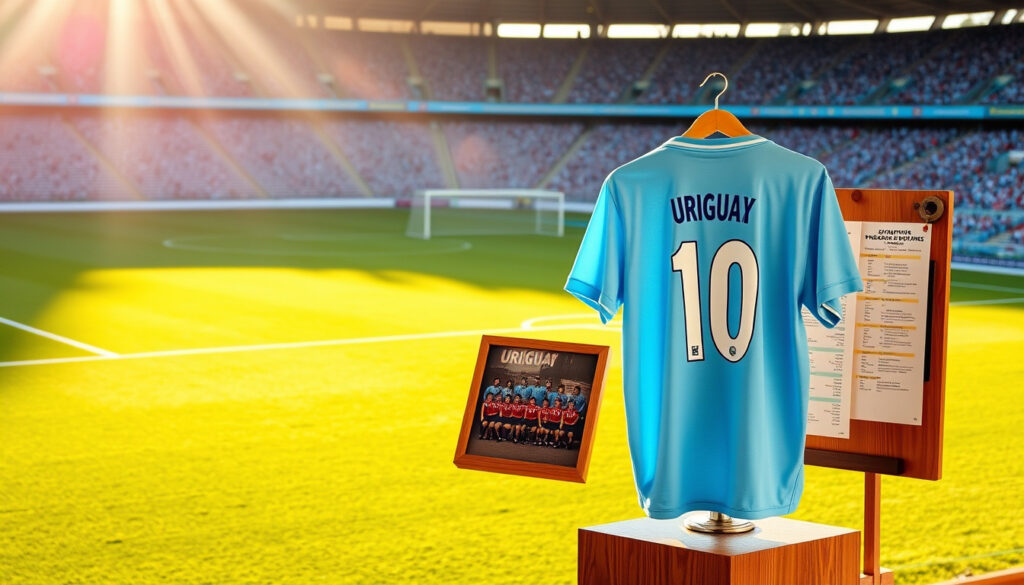
Uruguay National Football Team – Squad, Fixture , Hi tory and 2026 Kit
Uruguay, known as La Celeste, are one of football’s most storied nations. With two World Cup titles, a rich history of producing elite talent, and a new generation led by Federico Valverde and Darwin Núñez, the team is preparing for the 2026 FIFA World Cup under the guidance of Marcelo Bielsa. This guide covers the current squad, upcoming fixtures, legendary players, kit details, and the team’s enduring significance in global football.
Few national teams carry a legacy as heavy as Uruguay’s. The country of roughly 3.5 million people has consistently punched above its weight, winning the inaugural World Cup in 1930 and producing the iconic Maracanazo triumph in 1950. Today, that tradition continues with a squad that blends world-class talent from Europe’s top leagues with the tactical discipline that has long defined Uruguayan football.
With qualification for the 2026 tournament already secured, attention has turned to the squad Marcelo Bielsa will select. The current core is built around players such as Federico Valverde, Darwin Núñez, José María Giménez, Ronald Araújo, Manuel Ugarte, and Sergio Rochet. While the final roster will not be confirmed until closer to the tournament, the group provides a clear picture of Uruguay’s strengths.
Who are the current Uruguay national football team players?
The Uruguay squad for the 2026 World Cup cycle is a mix of established internationals and emerging talents. Under Marcelo Bielsa, the team has maintained a relatively stable core, with the biggest questions revolving around the final selection in goal and the inclusion of veteran attackers. The following overview provides a quick snapshot of the team’s key identifiers, followed by a detailed breakdown of the current roster.
World Cups
4 (1924, 1928, 1930, 1950) *Olympic titles counted
Home Kit
Sky blue shirt, black shorts
Next Match
Check fixtures below
Most Caps
Diego Godín (161)
Key insights about the Uruguay national team
- Uruguay remains one of the most successful national teams relative to population size, with two FIFA World Cup titles.
- The current squad blends experienced veterans with young talents such as Federico Valverde and Darwin Núñez.
- Key rivals include Argentina and Brazil, with the Copa América providing the primary continental context.
- Uruguay has already qualified for the 2026 FIFA World Cup, securing its place in the tournament.
- The team is managed by Marcelo Bielsa, who was appointed in 2024 and brings a distinct tactical identity.
- Squad depth, particularly in attack and goalkeeper positions, remains a topic of discussion ahead of the final roster selection.
Uruguay national football team – snapshot facts
| Category | Detail |
|---|---|
| Founded | 1901 (first match in 1902) |
| FIFA code | URU |
| Nickname | La Celeste (The Sky Blue) |
| Home stadium | Estadio Centenario, Montevideo |
| Current head coach | Marcelo Bielsa (as of 2025) |
| Most caps | Diego Godín (161) |
| Top scorer | Luis Suárez (68 goals) |
| World Cup best | Champions (1930, 1950) |
| Copa América titles | 15 (most recent 2011) |
Current squad breakdown by position
Based on the most up-to-date squad lists, the following players are regularly included in the Uruguay setup for the 2026 cycle. Exact final tournament roster decisions can still change before kickoff, but these are the names most frequently cited across multiple sources.
Goalkeepers
Sergio Rochet, Santiago Mele, Fernando Muslera, and Franco Israel. Much of the discussion around the goalkeeping department centres on whether veteran Fernando Muslera will retain his place alongside Rochet and Mele in the final tournament squad.
Defenders
José María Giménez, Ronald Araújo, Sebastián Cáceres, Guillermo Varela, Mathías Olivera, Matías Viña, Santiago Bueno, José Luis Rodríguez, and Joaquín Piquerez. This group combines experience at the highest level with younger options who have been integrated under Bielsa.
Midfielders
Manuel Ugarte, Federico Valverde, Giorgian de Arrascaeta, Nicolás de la Cruz, Maximiliano Araújo, Emiliano Martínez, Facundo Pellistri, Juan Manuel Sanabria, Nicolás Fonseca, and Joaquín Piquerez (depending on source classification). The midfield is widely regarded as Uruguay’s strongest unit, anchored by Valverde and Ugarte.
Forwards
Darwin Núñez, Agustín Canobbio, Brian Rodríguez, Federico Viñas, Facundo Torres, Agustín Álvarez, and Rodrigo Aguirre. In some sources, Pellistri is also grouped in attack. Núñez is the clear focal point up front, supported by a rotating cast of wide attackers.
What are the upcoming Uruguay national football team fixtures?
Uruguay’s match schedule for the 2026 World Cup is not yet fully confirmed, and different sources report conflicting fixture lists. The safest reading of the available information is that the pre-tournament schedules remain incomplete or inconsistent. For the most authoritative fixture confirmation, FIFA’s official team page is the recommended source.
Reported group-stage fixtures (subject to change)
One source lists Uruguay’s 2026 World Cup group fixtures as June 20 vs Cape Verde at MetLife Stadium in East Rutherford, and June 26 vs Spain at Mercedes-Benz Stadium in Atlanta. Another source states the group stage includes June 15 vs Saudi Arabia, June 21 vs Cape Verde, and June 26 vs Spain. Because these accounts conflict, no single fixture list can be presented as certain at this stage.
FIFA’s official Uruguay team page is the best source for confirmed match dates, venues, and opponents. Fans should check that page for the final group-stage schedule, as third-party sources have published inconsistent information.
How to stay updated on Uruguay match news
For ongoing coverage, the BBC Sport Uruguay team page provides regular match reports, results, and standings. The ESPN Uruguay team stats page offers squad statistics and performance data. Official announcements from the Uruguayan Football Association (AUF) and FIFA are the most reliable channels for fixture confirmations.
Who are the legends of the Uruguay national football team?
Uruguay’s status as a football powerhouse is built on a foundation of legendary players and unforgettable achievements. The team’s identity is inseparable from its two World Cup titles, and the players who delivered those triumphs remain central to the national story.
World Cup champions and the Maracanazo
Uruguay won the first ever FIFA World Cup in 1930 on home soil, defeating Argentina 4-2 in the final. The victory established the country as a force in world football. Twenty years later, in 1950, Uruguay produced the Maracanazo, one of the sport’s most famous upsets, beating Brazil 2-1 in the final match at the Maracanã Stadium in Rio de Janeiro. The victory silenced an estimated 200,000 home fans and remains a defining moment in football history.
Modern icons and current stars
The current generation includes players who are already well on their way to legendary status. Federico Valverde, with his dynamic midfield play for Real Madrid, is arguably the team’s most influential player. José María Giménez and Ronald Araújo provide a formidable defensive partnership, combining experience with athleticism. Diego Godín, the all-time leader in caps with 161 appearances, is another modern great, having captained the side for years and led the defence during the 2010 and 2018 World Cup campaigns. For those interested in following the team’s current stars, you can find a Rugby TV live stream here. Rugby TV live stream
All-time top scorer and historical greats
Luis Suárez holds the record as Uruguay’s all-time top scorer with 68 goals, a mark that reflects his longevity and ruthlessness in front of goal. The broader set of Uruguayan legends extends well beyond the scope of any single article, but the team’s historical identity is strongly linked to its two World Cup titles and long-standing status as a South American giant.
The Uruguay national team is universally known as La Celeste (The Sky Blue), a name derived from the sky blue shirts they have worn for over a century. The nickname is deeply woven into the country’s football culture and is used by fans, media, and the federation alike.
What is the Uruguay national football team shirt design?
Uruguay’s traditional kit is among the most recognisable in international football. The home shirt is sky blue with white trim, paired with black shorts and black or blue socks. The away kit is typically white. This colour scheme has been consistent for generations and is directly tied to the team’s nickname, La Celeste.
The search results do not provide a verified 2026 kit announcement or full shirt description. Uruguay’s kit supplier is Puma, but no confirmed design for the 2026 World Cup has been released in the available sources. For a confirmed 2026 kit, the FIFA team page and national federation updates are the most reliable places to check.
The sky blue shirt has been a constant throughout Uruguay’s history, worn during both World Cup triumphs and every major tournament since. The colour carries deep cultural significance in Uruguay and is a source of national pride. Any future kit design will almost certainly retain the sky blue base that defines the team’s visual identity.
As of the available information, no official 2026 World Cup kit has been announced. The traditional sky blue shirt and black shorts remain the team’s established look, but fans should wait for official confirmation from Puma or the Uruguayan Football Association before purchasing a 2026 jersey.
What is the World Cup history of Uruguay?
Uruguay has appeared at the FIFA World Cup in 1930, 1950, 1954, 1962, 1966, 1970, 1974, 1986, 1990, 2002, 2010, 2014, 2018, and 2022. Their best finishes are champions in 1930 and 1950. The long tournament history and two titles make Uruguay one of the classic World Cup powers.
- 1901 – Uruguay national team formed. First official match took place in 1902.
- 1930 – Hosts and wins the first FIFA World Cup, defeating Argentina 4-2 in the final.
- 1950 – The Maracanazo: Uruguay beats Brazil 2-1 in the final match at the Maracanã to win its second World Cup.
- 2011 – Wins Copa América for the 15th time, the most recent continental title.
- 2018 – Reaches the World Cup quarterfinals, losing to France 2-0.
- 2024 – Marcelo Bielsa appointed as head coach, ushering in a new tactical era.
What is confirmed and what remains uncertain about the Uruguay squad?
While much is known about Uruguay’s current setup, some details remain unresolved ahead of the 2026 World Cup. The table below separates what is firmly established from what is still unclear.
| Established information | Information that remains unclear |
|---|---|
| Uruguay has won two official FIFA World Cups (1930, 1950). | The final 2026 World Cup squad is not yet confirmed; players will be selected based on form and qualification progress. |
| The current squad includes Federico Valverde, Darwin Núñez, José María Giménez, Ronald Araújo, Manuel Ugarte, and Sergio Rochet. | The status of veteran players such as Luis Suárez and Edinson Cavani remains speculative. |
| Marcelo Bielsa is the head coach as of the 2026 cycle. | The exact group-stage fixtures and venues for the 2026 World Cup are reported inconsistently across sources. |
What is Uruguay’s place in world football?
Uruguay is considered by FIFA as football’s first global powerhouse, a status earned through its early dominance and enduring competitiveness. The country consistently ranks among South America’s top teams and is currently navigating CONMEBOL World Cup qualification with a competitive squad under Bielsa. Despite a population of only 3.5 million, Uruguay’s football tradition, tactical discipline, and ability to produce world-class players keep it relevant on the biggest stages.
The team’s tactical profile is built on disciplined defence, a strong midfield anchored by Valverde and Ugarte, and lethal counter-attacks. This approach has served Uruguay well in recent tournaments, including a quarterfinal appearance in 2018 and competitive performances in the 2022 group stage. The appointment of Bielsa in 2024 suggests a shift toward a more aggressive, high-pressing style, though the core defensive principles remain intact.
Uruguay’s historical significance extends beyond trophies. As the host and winner of the first World Cup, the country occupies a special place in the sport’s origin story. The Maracanazo in 1950 is regularly cited as one of the greatest upsets in football history, and the image of captain Obdulio Varela lifting the trophy in Rio remains a powerful symbol of Uruguayan resilience. The team’s nickname, La Celeste, is recognised worldwide. CONMEBOL remains the governing body for South American football, and Uruguay’s home matches are played at the historic Estadio Centenario in Montevideo.
What do official sources say about Uruguay?
Reliable sources consistently highlight Uruguay’s proud footballing tradition and competitive edge. The following quotes capture the consensus view across major sports media and reference platforms.
“Uruguay is considered by FIFA as football’s first global powerhouse.”
— Wikipedia
“Uruguay have a proud footballing tradition and remain a force in international football.”
— BBC Sport
“The 2026 roster includes a mix of youth and experience under manager Marcelo Bielsa.”
— ESPN
The BBC Sport Uruguay team page provides current news, results, and analysis. The ESPN Uruguay team stats page offers squad statistics and performance data updated through the 2026 qualification cycle.
What is next for Uruguay?
Uruguay enters the 2026 World Cup as a dangerous outsider, with a squad that blends elite talent at key positions with the tactical organisation that Bielsa demands. The next steps involve confirming the final group-stage fixtures, monitoring player form and fitness through the remainder of the qualification process, and tracking any kit or squad announcements from the federation. Fans should follow official FIFA channels and the Uruguayan Football Association for the most accurate and timely information. FIFA’s official World Cup site remains the primary source for tournament details.
For further reading on other national teams, see the Hungary National Football Team – Squad, History and World Cup 2026 guide. For gaming and sports simulation news, the EA Sport FC 26 – Release Date Price Platform and New Feature article provides relevant coverage.
Frequently asked questions about Uruguay
How many World Cups has Uruguay won?
Uruguay has won two official FIFA World Cups: 1930 (as hosts) and 1950 (the Maracanazo). They also won Olympic gold in 1924 and 1928, which are sometimes counted as world championships.
Who is the Uruguay national football team head coach?
As of 2025, the head coach is Marcelo Bielsa, who was appointed in 2024.
What is the nickname of the Uruguay national team?
They are known as La Celeste (The Sky Blue), after their sky blue jerseys.
Where does Uruguay play their home matches?
Most home matches are played at the Estadio Centenario in Montevideo.
Who is Uruguay’s all-time top scorer?
Luis Suárez holds the record with 68 goals (as of 2025).
Has Uruguay qualified for the 2026 World Cup?
Yes, Uruguay have qualified for the 2026 FIFA World Cup.
Who are Uruguay’s biggest rivals?
Uruguay’s primary rivals are Argentina and Brazil, with matches in the Copa América and World Cup qualifiers carrying particular intensity.
What is the Maracanazo?
The Maracanazo refers to Uruguay’s 2-1 victory over Brazil in the 1950 World Cup final, played at the Maracanã Stadium in Rio de Janeiro. It is widely regarded as one of the biggest upsets in football history.
What color is Uruguay’s home kit?
Uruguay’s home kit is a sky blue shirt with white trim, black shorts, and black or blue socks. The away kit is typically white.
How many Copa América titles has Uruguay won?
Uruguay has won the Copa América 15 times, with the most recent title coming in 2011.
More related posts
 Wheels on the Bus – Lyrics, History and Toddler Benefits
 Wrap of the Day McDonalds – Full UK Weekly Schedule
 Update Address on Driving Licence – Free Step-by-Step Guide
 Scott Disick – Net Worth, Kids, Weight Loss in 2025
 How to Create a Poll on WhatsApp – Complete Android iPhone Guide
 Edward Furlong 2025 – Biography, Net Worth and Where He Is Now
 How Many Fridays Until Christmas – Live 2026 Countdown
 Share Code for Employer – Full Guide to Right to Work Checks