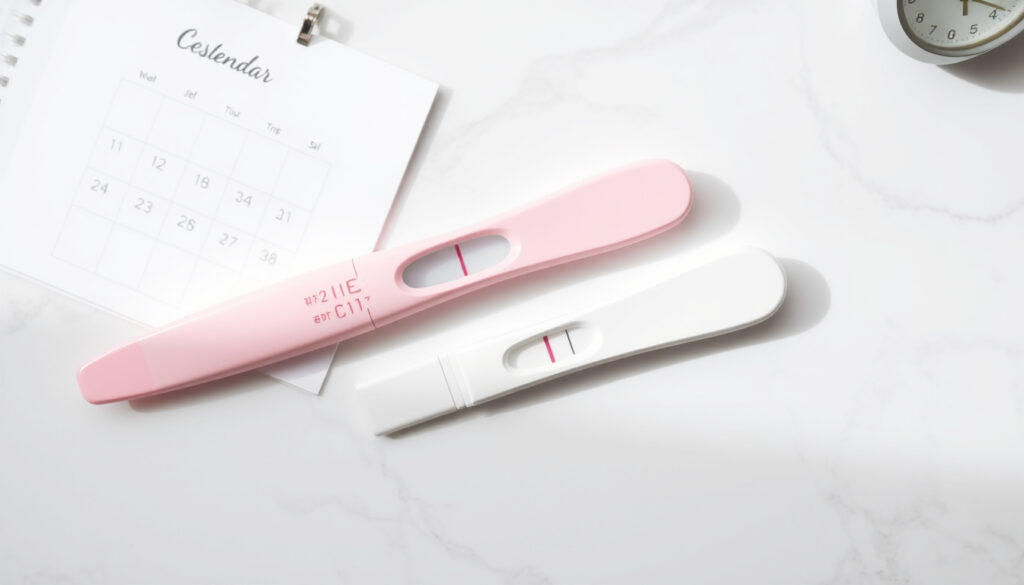
False Positive Pregnancy Test – Causes, Chances and How to Confirm
A false positive pregnancy test is when the test says you are pregnant but you are not carrying a pregnancy. This outcome is uncommon, but it can happen when the test detects human chorionic gonadotropin (hCG) in your urine for reasons other than an ongoing pregnancy, or when the test is used or read incorrectly.
Home pregnancy tests work by detecting hCG, a hormone that rises rapidly after implantation. If hCG is present from a source other than a current pregnancy — such as residual hormones after a miscarriage, fertility medications, or certain medical conditions — the test can show a positive result even when no viable pregnancy exists.
Most people who see a positive line are indeed pregnant, but understanding the rare scenarios that can produce a false positive helps reduce confusion and unnecessary worry. This article explains the known causes, how often they occur, and what steps to take next.
What Causes a False Positive Pregnancy Test?
Medical conditions (ovarian cysts, kidney disease), user error, evaporation lines, recent pregnancy loss, and certain medications.
hCG-containing fertility drugs, some diuretics, antipsychotics; rare cancers (ovarian, testicular, lung) can produce hCG.
False positives are very rare (less than 1% in typical use). Most “false positives” are due to early chemical pregnancies or evaporation lines.
Wait a few days and retest, use a blood test at your doctor, or check for signs of miscarriage early.
- False positive pregnancy tests are rare; most unexpected positives are real (implantation or chemical pregnancy).
- The single most common cause of a false positive is an evaporation line misread as a faint positive.
- Certain medications like fertility drugs with hCG can directly cause a false positive for up to 10 days after injection.
- Medical conditions that elevate hCG (e.g., trophoblastic disease, testicular cancer) are extremely rare causes.
- User error — such as reading the test after the recommended time window — frequently leads to misinterpretation.
- Testing too early, using diluted urine, or an expired test can produce inaccurate results.
- False positives are less common than false negatives, which happen when hCG is present but the test fails to detect it.
| Fact | Detail |
|---|---|
| Typical false positive rate | <1% with modern test brands |
| Most common cause | Evaporation lines (especially with blue-dye tests) |
| Timeframe after miscarriage | hCG can remain detectable 4–6 weeks after loss |
| Effect of fertility drugs | hCG trigger shot can cause positive for up to 10 days |
| UTI impact | Severe UTI with blood/protein can rarely cause false positive |
| Cancer link | Extremely rare; only certain hCG-secreting tumors |
What Drugs and Cancers Can Cause a False Positive Pregnancy Test?
Medications That May Interfere
The clearest medication-related cause is hCG-containing fertility injections used to trigger ovulation. These drugs are designed to mimic the natural hCG surge and can be detected by home tests, creating a false positive for up to 10 days after the injection. Most routine medications, including antibiotics and birth control pills, do not affect home pregnancy test accuracy, as confirmed by the Mayo Clinic and Clearblue.
Birth control pills and most antibiotics do not cause false positive pregnancy tests. The only widely documented drug-related cause is hCG-containing fertility medications. Always check with your pharmacist if you are unsure about a specific prescription.
Cancers and Other Rare Conditions
Certain cancers can produce hCG, including ovarian, testicular, and lung tumors, as well as trophoblastic diseases. The mechanism is well established biologically, but the incidence is extremely low and there is no population-level data on how often this leads to a false positive test. Clearblue notes that medical conditions such as ovarian cysts, kidney disease, and menopause-related hormone changes can also occasionally raise hCG levels.
Can I Get a False Positive Pregnancy Test? (Chances and Scenarios)
How Common Are False Positives?
False positives are very rare. With modern test brands, the rate is consistently reported as less than 1%. Most unexpected positives are real, often resulting from implantation or a very early chemical pregnancy. The American Pregnancy Association notes that chemical pregnancies — extremely early miscarriages — are a common reason a positive test may be followed by a negative or period-like bleeding.
User Error and Evaporation Lines
User mistakes are one of the most frequent preventable causes. Testing too early, using an expired test, reading the result after the recommended time window, or drinking too much fluid beforehand can all produce misleading results. Evaporation lines — faint lines that appear after the test dries — are a classic source of false interpretation and do not indicate the presence of hCG.
If you get a positive result and feel uncertain, wait 48–72 hours and take another test using first-morning urine. Pink-dye tests tend to have fewer evaporation line issues than blue-dye tests. If still positive, confirm with a quantitative blood hCG test at your healthcare provider.
What Does a False Positive Pregnancy Test Look Like?
Evaporation Line vs. True Positive
An evaporation line is a faint, colorless line that can appear after the urine has dried on the test strip, usually after the recommended reading window. It looks similar to a faint positive line but lacks color (often grayish). In contrast, a true positive line usually has a distinct pink or blue tint depending on the test brand. Reading results within the time specified in the instructions — typically 3 to 5 minutes — helps avoid confusion.
If you see a line appear after the test reading window has closed (e.g., more than 10 minutes after testing), ignore it. That line is not a reliable indicator of pregnancy. Only the result visible within the manufacturer’s time frame is valid.
How to Avoid Misreading
Always check the expiration date, use first-morning urine for highest hCG concentration, and read the result in good lighting. If the line is very faint, take another test two days later. A true positive will typically get darker as hCG doubles every 48–72 hours in early pregnancy.
Timeline: When False Positive Pregnancy Tests Can Occur
- Immediately after miscarriage or birth: hCG levels take weeks to drop. A test within 4–6 weeks may still be positive, not a new pregnancy.
- After fertility treatment (hCG trigger shot): Positive test possible for up to 10 days; may be misinterpreted as false positive if pregnancy not established.
- After a chemical pregnancy: Very early pregnancy loss can cause a positive test then later negative, perceived as false positive.
- During active UTI or kidney disease: False positives can occur due to protein, blood, or leukocytes in urine.
- Test reading window: Reading after recommended time (e.g., >10 min) can cause evaporation lines that look positive.
Certainty vs. Uncertainty: What We Know and What’s Unclear
| Topic | Established Information | Information That Remains Unclear |
|---|---|---|
| False positive due to evaporation lines | Confirmed – line appears after test dries | — |
| False positive from medical conditions | Known mechanisms but rare | Some conditions (e.g., HAMA interference) are poorly understood |
| Drug interactions | Well documented for hCG drugs | Unclear for some rare medications – case reports only |
| Cancer as a cause | Established biological mechanism | Extremely low incidence – no population-level data |
| Incidence rate | Confidence high (<1%) | Variability by test brand and user population |
What Do False Positive Results Actually Mean?
False positive pregnancy tests can create unnecessary anxiety, but the reality is that true false positives (outside chemical pregnancies or medication interference) are very rare. The National Institutes of Health notes that substances such as leukocytes or human anti-mouse antibodies (HAMA) can interfere with urine hCG tests, but these are unusual. For most people, a positive home test is a reliable indicator of pregnancy.
When a false positive does occur, it is often due to a chemical pregnancy — an early loss that happens before a missed period. This can be emotionally difficult, but it does not mean you cannot conceive successfully in the future. If you are unsure about your test result, a healthcare provider can offer a blood test for definitive confirmation.
The NHS advises that serious urinary tract infections with high levels of white blood cells, red blood cells, and nitrite can occasionally cause false positives. If you have symptoms of a UTI and a positive pregnancy test, seek medical advice.
What Do Medical Authorities Say About False Positives?
“A false-positive might happen if you had a pregnancy loss soon after the fertilized egg attached to the uterine lining.”
— Mayo Clinic
“What medical conditions could give me a false positive? ovarian cysts, kidney disease, certain cancers, disorders that affect hormone production.”
— Clearblue
“Serious urinary tract infections (with high levels of WBC, RBC and nitrite) can occasionally cause a false positive pregnancy test result.”
— NHS Gloucestershire Hospitals
False Positive Pregnancy Test: Key Takeaways
False positive pregnancy tests are uncommon, and most positive results are accurate. If you are uncertain, wait two days and retest with a pink-dye test using first-morning urine. Confirmation with a blood test from your doctor is the most reliable next step. For further guidance on the journey ahead, see How to Choose a Baby Name – Step-by-Step Guide for UK Parents and Healthy Start Card Number – Where to Find and Activate.
Frequently Asked Questions About False Positive Pregnancy Tests
Can a false positive pregnancy test happen after a period?
It can if you had a very early miscarriage (chemical pregnancy) or if you still have residual hCG from a previous pregnancy. Otherwise, it’s unlikely.
Does alcohol or caffeine cause a false positive?
No. Alcohol and caffeine do not interfere with pregnancy test chemistry.
Can antibiotics cause a false positive pregnancy test?
Most common antibiotics do not cause false positives, but some (e.g., certain diuretics, antipsychotics) might. Check with your doctor.
What should I do if I think I have a false positive?
Wait a few days and retest using a pink-dye test. If still positive, see your healthcare provider for a blood test.
Can a digital pregnancy test give a false positive?
Yes, but less likely for evaporation lines. Digital tests also have a threshold; a chemical pregnancy can still show ‘Pregnant’.
How long after a miscarriage can a false positive occur?
hCG can remain detectable for 4–6 weeks after a pregnancy loss. Testing within that window may show a positive that is not a new pregnancy.
Can a UTI cause a false positive pregnancy test?
In rare cases, a severe UTI with blood, protein, or high leukocytes can interfere with the test and cause a false positive.
What is the difference between a false positive and a false negative?
A false positive says you’re pregnant when you’re not; a false negative says you’re not pregnant when you are. False negatives are more common.
Can stress cause a false positive pregnancy test?
No. Stress does not produce hCG in the body and cannot cause a false positive result.
Are some pregnancy test brands more likely to give false positives?
Blue-dye tests are more prone to evaporation lines, which can be mistaken for positives. Pink-dye tests are generally clearer. Always follow the timing instructions.
More related posts
 Sheryl Crow – Her Greatest Songs and Career Highlights
 Ariana Greenblatt – Age, Height, Parents, Ahsoka Career
 Jarrod Bowen – Career Stats, Net Worth, and Personal Life
 Clare Holman – Biography, Age, Career and Net Worth
 Ben Shephard Wife – Biography, Family and the Truth Behind the Rumors
 Mos Def – Net Worth, Biography and Personal Life
 Crazy Hair Day Ideas – Boys Girls Last-Minute Styles
 Frankie Dettori – A Legendary Career Comes to an End