Can Anyone Do a Bro Split – Suitability Pros Cons Alternatives
The bro split remains one of the most recognizable training routines in commercial gyms, characterized by dedicated days for chest, back, legs, and arms. Despite its popularity among recreational lifters, exercise scientists have increasingly questioned whether this once-dominant approach suits everyone—or if it represents an outdated relic of bodybuilding’s past.
Understanding who can effectively implement this training style requires examining decades of research on muscle protein synthesis, training frequency, and individual recovery capacity. While the routine offers certain advantages for specific populations, emerging evidence suggests clear limitations for novice lifters and those seeking maximal hypertrophy.
This analysis evaluates the biological mechanisms, historical context, and practical constraints that determine whether a bro split workout structure aligns with your training experience and physique goals.
What Is a Bro Split?
Definition: 5-6 day muscle group split
Best for: Intermediate/advanced lifters
Frequency: 1x per muscle group/week
Goal: Hypertrophy via high volume
- Isolation Focus: Targets single muscle groups with 10-12 sets per session, contrasting with full-body approaches distributing volume across multiple muscles.
- Time Commitment: Requires 5-6 training days weekly to cycle through all major body parts.
- Volume Concentration: Uses high volume in single sessions rather than moderate volume spread across the week.
- Beginner Limitations: Not optimal for novices despite widespread gym adoption.
- Historical Roots: Originated in 1970s bodybuilding culture, predating modern frequency research.
- Maintenance Utility: Requires less volume to maintain muscle than to build it, making it suitable for specific phases.
| Fact | Details |
|---|---|
| Days/Week | 5-6 |
| Experience Level | Intermediate+ |
| Volume/Muscle | High (10-20 sets) |
| Recovery Demand | High |
| Best Goal | Hypertrophy |
| Frequency | 1x per week per muscle |
| Session Structure | Single muscle group focus |
Can Beginners Do a Bro Split?
Bro splits are not the optimal choice for beginners. If forced to choose between a bro split and a PPL routine, a PPL performed 4-5 days per week is recommended for beginners who want to progress in muscle gain. The physiological adaptations of novice lifters respond more favorably to frequent motor pattern practice and moderate systemic fatigue.
Who Should Avoid This Approach
Individuals with fewer than 12 months of consistent resistance training lack the work capacity and technical proficiency to benefit from marathon sessions targeting isolated muscle groups. The high volume per session often exceeds their recovery capabilities, leading to excessive soreness and interrupted training continuity.
Better Starting Points
However, beginners don’t require as much overall training volume as intermediate and advanced lifters and often perform equally well with a 3-day full-body routine or 4-day upper/lower split. These alternatives provide the twice-weekly frequency per muscle group that research consistently associates with superior early-phase strength and size development.
Beginners lack the neuromuscular efficiency to maintain intensity across 10-12 sets for a single muscle, often resulting in junk volume—extra sets that provide stimulus without corresponding adaptation.
Is a Bro Split Effective for Muscle Growth?
Research demonstrates that higher training frequency produces superior hypertrophy results. A 2019 study on trained lifters found that after 8 weeks, almost every muscle measured grew more with a full-body workout split compared to a bro split, with full-body workouts scoring 10.0 on hypertrophy effectiveness—the highest by a significant margin.
The Frequency Evidence
This aligns with the principle that each muscle group should be trained more than once per week for optimal muscle growth. Protein synthesis remains elevated for 24-48 hours post-training; weekly bro split cycles miss this window, allowing anabolic sensitivity to decline before the next stimulus.
Volume Distribution Dynamics
The key distinction is that bro splits rely on high volume in a single session (10-12 sets per muscle group once weekly), while distributed approaches use moderate volume spread across multiple sessions. Research suggests the distributed approach produces better results for hypertrophy.
Meta-analyses consistently indicate that training muscle groups 2-3 times weekly maximizes muscle protein synthesis responses compared to once-weekly bombardment.
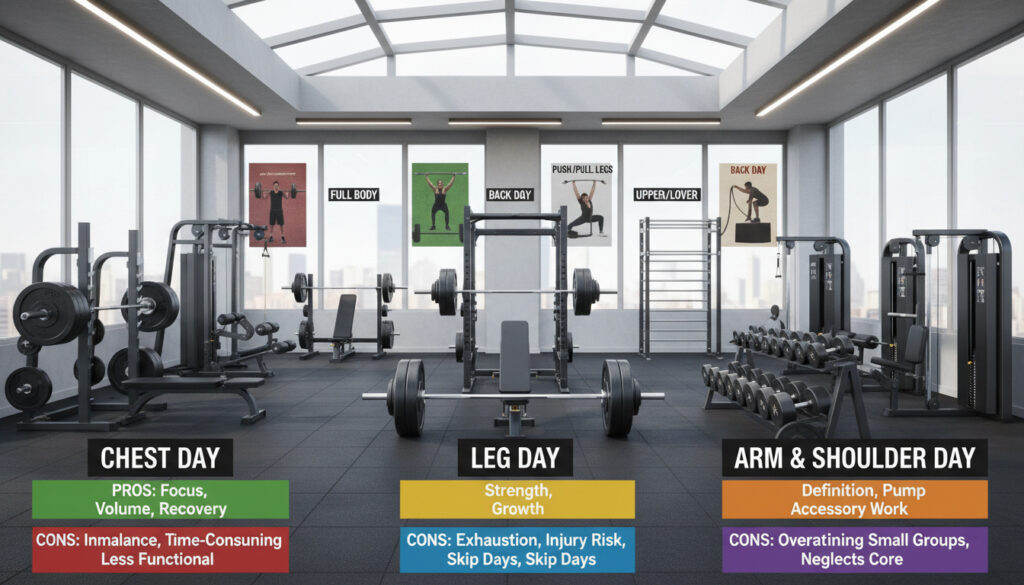
Pros and Cons of a Bro Split
Distinct Advantages
- High Intensity per Session: Allows you to train each muscle with high effort intensity, as you’re not fatigued from other muscle groups.
- Muscle Pump: Dedicating an entire session to one muscle group creates greater pump and localized volume.
- Targeted Development: Effective for addressing specific lagging body parts, such as chest-only training.
- Personalization: Works well for those who prefer focusing intensely on upper body aesthetics.
Significant Limitations
- Lower Training Frequency: Muscles trained once weekly is suboptimal for hypertrophy.
- Slower Gains: Growth comes more slowly compared to higher-frequency splits.
- Variable Intensity: Some lifters lose steam toward the end of workouts, reducing intensity for muscles trained last.
Takes less training volume to maintain muscle compared to building it, making bro splits useful for maintenance phases when maximal growth is not the primary objective.
Bro Split vs. Other Workout Splits
A bro split targets a single major muscle group once per week across 4-6 training days, typically using 10-12 sets per muscle group. This contrasts with full-body workouts that use 3-4 sets per muscle group but train all major muscles 2-4 times weekly.
A PPL split divides training by movement patterns: push days target chest, shoulders, and triceps; pull days target back and biceps; and leg days isolate the lower body. This allows you to train muscle groups together that naturally work synergistically in compound lifts. For those evaluating options, examining Bro Split vs PPL methodologies reveals significant differences in frequency and time commitment.
PPL routines are more effective for rapid muscle gain than bro splits because they provide higher training frequency while maintaining workout manageability. However, a 3-day PPL has a significant weakness: each muscle group is trained only once weekly, which is less than ideal for growth. To optimize results, PPL requires 5-6 training days per week. Another comparison of Bro Split vs PPL approaches highlights that PPL promotes even body development and time efficiency through compound movements.
For those with limited availability, a PPL or full-body routine is preferable to a bro split, as they provide adequate stimulus with fewer than 4-6 training days per week.
How Did the Bro Split Evolve Through Fitness History?
- — Golden Era bodybuilding popularizes muscle-group isolation, with champions like Arnold Schwarzenegger training six days weekly using body part divisions.
- — Muscle magazines cement “chest day” and “arm day” culture, establishing the bro split as the default gym routine for aesthetic goals.
- — Scientific examination of training frequency begins challenging the assumption that weekly destruction of single muscles optimizes growth.
- — A comparative study demonstrates full-body superiority for hypertrophy in trained lifters.
- — Evidence-based training shifts toward higher frequency approaches, though bro splits persist in commercial gym culture.
What Is Established vs. Still Debated?
| Established Facts | Information That Remains Unclear |
|---|---|
| 2x/week frequency superior to 1x for hypertrophy | Whether bro splits cause higher injury rates in novices |
| Beginners need less volume than advanced lifters | Optimal session length for single-muscle specialization |
| 10-12 sets per muscle sufficient for maintenance | Long-term adherence differences between split types |
| PPL provides more balanced development than bro splits | Individual genetic variation in recovery from high-volume sessions |
What Historical Context Shaped the Bro Split?
The bro split emerged from the pharmacologically enhanced training environments of the 1970s, where enhanced recovery capacity allowed athletes to thrive on weekly muscle bombardment. Bodybuilders of that era popularized the concept of “attacking” a muscle from multiple angles in marathon sessions, creating a cultural template that outlived its original physiological context.
As natural bodybuilding and evidence-based fitness gained traction, researchers recognized that drug-free lifters recover differently. The split that built champions under specific chemical conditions often produced subpar results for natural athletes training without pharmaceutical support, driving the shift toward frequency-based programming seen in modern strength coaching.
What Do the Sources Indicate?
PPL routines are more effective for rapid muscle gain than bro splits because they provide higher training frequency while maintaining workout manageability.
— Muscle Evo Analysis
This allows you to train muscle groups together that naturally work synergistically in compound lifts.
— Leading Edge NY
For those with limited availability, a PPL or full-body routine is preferable to a bro split.
— 1Up Nutrition Training Analysis
Is a Bro Split the Right Choice for You?
Select a bro split only if you train 4-6 days weekly, prioritize maintenance over growth, enjoy intense single-muscle focus, or address specific lagging body parts. Otherwise, examining Bro Split vs PPL alternatives likely reveals more efficient paths to your physique goals, particularly if you are a beginner or natural lifter seeking maximal hypertrophy.
Frequently Asked Questions
How many days a week is a bro split?
A bro split typically requires 5-6 training days per week to cycle through all major muscle groups, with each muscle trained once weekly.
Is a bro split optimal for hypertrophy?
No. Research indicates training muscles 2+ times weekly produces superior hypertrophy compared to the once-weekly frequency of bro splits.
What are alternatives to a bro split?
PPL (Push/Pull/Legs), full-body routines 3 days weekly, and upper/lower splits 4 days weekly all provide better frequency for most lifters.
Can you build muscle on a bro split?
Yes, but gains typically occur more slowly than with higher-frequency approaches due to suboptimal protein synthesis stimulation.
Is a bro split good for strength?
Not ideal. Strength development requires frequent practice of movement patterns, which bro splits provide insufficiently for compound lifts.
What is better for beginners than a bro split?
Beginners should consider 3-day full-body routines or 4-day upper/lower splits before attempting body part specialization.
More related posts
 Carl Thomas Dean – Husband of Dolly Parton Dies at 82
 Metal Slug Awakening Characters List – Tier Rankings and Season 4 Guide
 Floyd Mayweather – Record, Net Worth, Next Fight and Career
 Quentin Wilson – Cause of Death, Biography and Legacy
 شات جي بي تي – What It Is, How to Use and 2025 Updates
 Charlie Brooks – EastEnders Actress and Racehorse Trainer
 Mystic Meg Horoscope Today – Archival Predictions and Legacy Guide
 Alvin and the Chipmunks – Characters, Films and Where to Watch