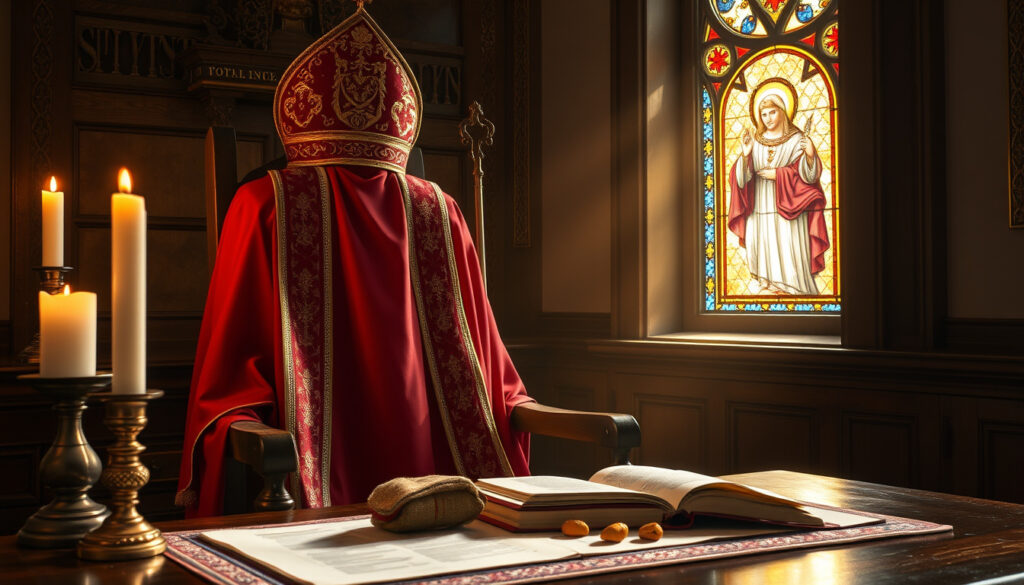
St Nicholas – The Real Bishop Behind Santa Claus
The figure known today as Santa Claus has a long and complex history that begins not at the North Pole, but in the ancient Mediterranean. Behind the red suit and sleigh lies a real person: a 4th-century Christian bishop named Nicholas, who lived in the Roman province of Lycia, in what is now Turkey. His reputation for secret generosity and his care for the vulnerable made him one of the most beloved saints in Christian history.
Over the centuries, the story of Nicholas travelled across cultures and languages, merging with local winter traditions to create the modern Santa Claus. But the historical bishop remains a figure of significant interest in his own right, with a feast day, a vast network of patronages, and a set of legends that have shaped gift-giving customs for generations.
This article separates the well-established facts from the later embellishments, tracing the journey from a real bishop in Myra to a global icon of generosity.
Who Was Saint Nicholas? A Biography of the Real St. Nicholas
St. Nicholas (c. 270–343 AD) was a 4th-century Christian bishop of Myra (modern-day Turkey).
Icon of generosity and gift-giving; the model for Santa Claus.
December 6 (Western and Eastern churches).
Children, sailors, merchants, archers, brewers, pawnbrokers, and more.
- St. Nicholas is one of the most venerated saints in both Eastern and Western Christianity, but his historicity is well-documented despite sparse contemporary records.
- The evolution from St. Nicholas to Santa Claus is a fascinating blend of religious tradition, folklore, and commercialization, with key steps in the Netherlands and the United States.
- His reputation as a secret gift-giver stems directly from the famous legend of providing dowries for three impoverished girls.
- Many modern Christmas customs, including the hanging of stockings and midnight gift-giving, have roots in St. Nicholas traditions.
- By the Renaissance, he was described as the most popular saint in Europe, a testament to the reach of his cult.
- His patronage expanded over the medieval period as devotion spread across the continent, linking him to diverse groups from sailors to brewers.
| Aspect | Details |
|---|---|
| Full Name | Nicholas of Myra (Greek: Νικόλαος) |
| Born | c. 270 AD, Patara, Lycia (Asia Minor) |
| Died | c. 343 AD, Myra |
| Office | Bishop of Myra |
| Venerated in | All Christian denominations that venerate saints (Catholic, Orthodox, Anglican, Lutheran) |
| Major shrine | Basilica di San Nicola, Bari, Italy (relics transferred in 1087) |
| Feast day | 6 December (main), also 9 May (translation of relics) |
| Symbols | Bishop’s mitre, three gold balls, anchor, boat |
| Canonization | Pre-congregation (ancient saint) |
Nicholas was born around 270 AD in the coastal city of Patara. Historical records indicate he came from a wealthy family and used his inheritance to help the poor, the sick, and the suffering, according to the St. Nicholas Center. He later served as bishop of Myra, a port city that was an important hub in the eastern Roman Empire. His death on December 6, 343 AD, became the focal point of his annual commemoration.
Early Life and Bishopric in Myra
Little can be confirmed about Nicholas’s early life with absolute certainty. One source notes that beyond his existence as a sainted bishop in the 300s, “there’s not much we can say for sure,” as reported by the Christmas Past podcast. What is generally accepted is that he was ordained as a bishop of Myra while still relatively young, and that his pastoral work was marked by a strong commitment to charity.
Historical Evidence and Timeline
The earliest written references to Nicholas appear in the 6th century, several hundred years after his death. Despite this gap, the consistency of the core details across multiple early sources—his role as a bishop, his location in Myra, and his reputation for generosity—gives historians confidence in the broad outline of his life. The Encyclopædia Britannica treats him as a historical figure, while noting that many of the miracles attributed to him belong to later hagiographic tradition.
Death and Veneration
Nicholas died in Myra on December 6, 343 AD. His tomb quickly became a pilgrimage site. In 1087, merchants from Bari, Italy, transported his relics to their city, where they remain enshrined in the Basilica di San Nicola. Part of the relics are also held in Venice at San Nicolò al Lido. This transfer helped spread his cult throughout western Europe.
Is Saint Nicholas the Same as Santa Claus? The Origins of the Christmas Legend
The short answer is that Saint Nicholas and Santa Claus are not the same figure, but the latter is directly derived from the former. The name Santa Claus itself comes from the Dutch Sinterklaas, a shortening of Sint Nikolaas, as documented by the St. Tammany Parish Library. The connection, however, involves several centuries of cultural transformation.
From Bishop to Gift-Giver: The Evolution of the Legend
The historical Nicholas was remembered as a secret gift-giver, most famously in the story where he provided dowries for three impoverished sisters by tossing bags of gold through their window. This act of anonymous generosity became the seed from which the wider gift-giving tradition grew. Over the medieval period, his feast day on December 6 became an occasion for giving small presents, especially to children.
Cultural Transformations: Dutch Sinterklaas to American Santa
Dutch settlers brought the Sinterklaas tradition to New Amsterdam (later New York) in the 17th and 18th centuries. There, the figure began to merge with English Father Christmas and other European winter gift-giving customs. In the 19th century, American writers such as Washington Irving and Clement C. Moore reshaped the character into a jolly, chimney-descending figure, as noted by multiple sources. The modern red suit and North Pole setting were largely solidified by 20th-century advertising, including Coca-Cola campaigns from 1931 onward.
The modern Santa Claus character—with his red suit, sleigh, reindeer, North Pole workshop, and chimney entries—is a later folklore and media creation. It does not come directly from the historical bishop as a complete character. The Wikipedia article on Saint Nicholas explains that the evolution involved poetry, advertising, and popular culture over many centuries.
Key Differences Between Saint Nicholas and Santa Claus
Saint Nicholas was a real 4th-century bishop who lived in Asia Minor, wore ecclesiastical vestments, and was known for charity and pastoral care. Santa Claus is a folkloric figure associated with the North Pole, a red suit, a sleigh pulled by reindeer, and the delivery of toys on Christmas Eve. While the name and the spirit of giving link them, the details of their stories are quite distinct.
What Is Saint Nicholas the Patron Saint Of? Exploring His Many Patronages
Saint Nicholas is one of the most widely invoked patron saints in Christianity. His patronage covers an unusually broad range of groups, from children and sailors to pawnbrokers and brewers. These roles are not random; they emerged organically from the legends associated with his life.
Patron Saint of Children, Sailors, and Merchants
His patronage of children derives from the legend that he saved or resurrected three boys who had been killed by an innkeeper. The story cemented his role as a protector of the young. His association with sailors comes from accounts of him calming storms and rescuing ships in distress. Because Myra was a port city, these maritime miracles were particularly resonant for the local community, as noted by the Greek Orthodox Archdiocese of America.
Other Patronages: Archers, Pawnbrokers, and Brewers
The list of patronages attributed to Saint Nicholas is extensive and sometimes surprising. According to multiple sources, he is also patron of merchants, travelers, bankers, pawnbrokers, archers, brewers, scholars, orphans, judges, captives, toymakers, unmarried people, and students. The three gold balls commonly associated with pawnbrokers are a direct reference to the three bags of gold he gave as dowries. His patronage of brewers may relate to accounts of a miracle involving a beer shortage during a famine.
How Patronage Ties to His Legends
Each patronage can be traced back to a specific deed or miracle. The dowry story explains his link to pawnbrokers and unmarried people. The saving of sailors explains his maritime patronage. The protection of children explains his role as their patron. This close connection between legend and patronage helped the cult of Saint Nicholas spread widely across Europe during the Middle Ages.
When Is Saint Nicholas Day and How Is It Celebrated?
Saint Nicholas Day is observed annually on December 6 in most Western and Eastern Christian traditions. Some Eastern churches that follow the Julian calendar celebrate it on December 19. The day marks the anniversary of his death and is a major feast in both Catholic and Orthodox calendars.
Date and Religious Observance
In many parts of Europe, Saint Nicholas Day remains a distinct holiday separate from Christmas. Children put out shoes or stockings on the evening of December 5, and wake up to find them filled with small gifts, fruits, nuts, or sweets. Churches hold special services honouring the saint, and his icon is often displayed prominently.
Traditions in Europe and Worldwide
The Netherlands and Belgium celebrate Sinterklaas on December 5 and 6, with parades and gift-giving. In Germany, children set out boots for St. Nikolaus to fill. In Greece and other Orthodox countries, the day is a major religious feast with liturgical celebrations. Even in regions where Santa Claus dominates the Christmas season, St. Nicholas Day is sometimes observed as a smaller, more intimate gift-giving occasion.
The tradition of children putting out stockings or shoes for Saint Nicholas is directly tied to the earliest stories about him. The St. Nicholas Center notes that this custom is a direct echo of the dowry story, where Nicholas dropped bags of gold through a window. The practice later merged with Christmas gift-giving in many cultures.
Saint Nicholas Day vs. Christmas Gift-Giving
In parts of Europe, St. Nicholas Day on December 6 is the primary occasion for children to receive presents, while Christmas focuses on religious observance and family gatherings. In the United States, by contrast, the gift-giving tradition shifted to Christmas Day during the 19th century, influenced by literature, newspapers, and commercial advertising. The two traditions remain distinct in many countries, each with its own customs and atmosphere.
While the custom of gift-giving on St. Nicholas Day is historically grounded, many elements of the modern Santa Claus story—including the sleigh, reindeer, North Pole workshop, and the chimney descent—are later additions from folklore, poetry, and advertising. They are not part of the historical record concerning the 4th-century bishop.
When Did Saint Nicholas Live? A Timeline of His Life and Legacy
- c. 270 – Born in Patara, Lycia (modern-day Turkey).
- c. 300 – Becomes Bishop of Myra, known for pastoral care and generosity.
- c. 325 – Traditionally attends the First Council of Nicaea (though this is debated among historians).
- 343 – Dies in Myra on December 6.
- 1087 – Relics stolen from Myra and taken to Bari, Italy, where they remain today.
- 13th century – Dutch traditions of Sinterklaas begin to take shape.
- 19th century – Washington Irving and Clement C. Moore popularize the Santa Claus figure in America.
- 1931 – Coca-Cola advertising campaigns help solidify the modern visual image of Santa Claus.
Certainty vs. Uncertainty: What Do We Really Know About Saint Nicholas?
Not everything about Saint Nicholas is equally well-established. Historians distinguish between information that is on solid ground and details that belong to later tradition or legend. The table below summarises the current scholarly consensus.
| Established Information | Information That Remains Unclear |
|---|---|
| He was a 4th-century bishop in Myra (Asia Minor) and died on December 6. | Exact birth and death years are approximate (c. 270–343). |
| He was widely venerated soon after his death. | Participation in the Council of Nicaea is possible but not universally accepted. |
| His relics were moved to Bari and Venice in the 11th century. | Many of the miracle stories (e.g., calming storms, resurrecting children) lack contemporary documentation and are considered legendary. |
| Multiple early Christian texts (e.g., by Methodius, Andrew of Crete) refer to him. | The details of his life have been embellished over centuries by hagiographers. |
What Is the Historical Context of Saint Nicholas?
Saint Nicholas emerged during a period of Christian consolidation after the Edict of Milan in 313, which legalised Christianity in the Roman Empire. As a bishop, he would have overseen a community in a strategically important port city. His reputation for secret gift-giving reflects both his personal charity and early Christian ideals of almsgiving.
The transformation of Nicholas into Sinterklaas and later Santa Claus mirrors broader cultural shifts. Dutch settlers brought the tradition to New Amsterdam. Nineteenth-century American writers reshaped him into a jolly, chimney-descending figure. Commerce later finalized the red suit and North Pole imagery. Understanding this evolution helps separate historical fact from festive folklore.
The widespread patronage—covering children, sailors, pawnbrokers, and many others—stems from specific legends that each group adopted. Sailors attribute their safe voyages to his intercession. Pawnbrokers use the three gold balls as a symbol of his dowry gift. These connections show how a single figure can serve many communities through the stories told about him.
Where Can You Find Reliable Information About Saint Nicholas?
Several authoritative sources provide well-researched information on Saint Nicholas. The Catholic Encyclopedia offers a detailed historical entry from a traditional Catholic perspective. The St. Nicholas Center maintains a dedicated biographical resource with scholarly references. The Encyclopædia Britannica provides a concise, encyclopedic overview. The Greek Orthodox Archdiocese of America publishes official liturgical information about his feast day.
“Saint Nicholas is the patron saint of sailors, merchants, archers, repentant thieves, children, brewers, pawnbrokers, toymakers, unmarried people, and students.”
— Wikipedia
“The true story of Santa Claus begins with Nicholas, who was born during the third century in the village of Patara in Asia Minor.”
— St. Nicholas Center
What’s Next? Further Exploration of Saint Nicholas
The story of Saint Nicholas offers many avenues for deeper exploration. Readers interested in the ecclesiastical dimension may wish to examine the full list of his patronages and their legendary origins. Those curious about the saint’s religious significance can explore his role in both Catholicism and Orthodoxy. For a broader view of how gift-giving figures evolved across cultures, the related article on When Is Mothers Day UK – 2026, 2027 Dates & Why It Changes provides useful context on how dates and traditions shift over time. Additionally, for those following the ecclesiastical calendar, the process for selecting church leadership is covered in Vatican Conclave Cardinals Pope Francis – 2025 Election Process Explained.
Frequently Asked Questions about Saint Nicholas
What is Saint Nicholas the patron saint of?
He is patron of many groups including children, sailors, merchants, archers, repentant thieves, brewers, pawnbrokers, toymakers, students, and unmarried people.
Why is Saint Nicholas associated with Christmas?
Because his feast day (December 6) falls in the Advent season and his tradition of secret gift-giving became intertwined with Christmas celebrations, especially after the Reformation shifted gift-giving to Christmas Day.
Is Saint Nicholas recognized in the Bible?
No, he is not mentioned in the New Testament. All knowledge of him comes from later hagiographies and church tradition.
What is the story of Saint Nicholas and the three girls?
A poor man had three daughters with no dowry. Nicholas secretly threw bags of gold through their window (or down the chimney) on three separate occasions, enabling them to marry.
Where is Saint Nicholas buried?
His relics are held in the Basilica di San Nicola in Bari, Italy, and partly in Venice (San Nicolò al Lido).
Is Saint Nicholas the same as Santa Claus?
Historically no—Santa Claus is a later folkloric figure inspired by St. Nicholas, mixed with Norse and other traditions. But the name ‘Santa Claus’ derives from ‘Sinterklaas’, the Dutch name for St. Nicholas.
When is Saint Nicholas Day?
December 6 in most traditions; some Eastern churches celebrate on December 19 (Julian calendar).
What are the symbols of Saint Nicholas?
A bishop’s mitre and staff, three gold balls (or apples), an anchor, a boat, and sometimes a man in a barrel (representing a saved child).
More related posts
 Healthy Start Card Number – Where to Find and Activate
 I’m A Celebrity Line Up 2025 – Full Contestants, Winner and Results
 Loving Poetry – The Best Love Poems for Him, Her and Every Moment
 Newcastle United F.C. vs Leeds United Stats – H2H Record
 Crazy Hair Day Ideas – Boys Girls Last-Minute Styles
 Oliver Tree – Death Hoax Debunked: Facts vs Misinformation
 Amanda Anisimova – Complete Profile and Career Stats
 Laila Cunningham – Age, Husband, Net Worth and Reform UK Candidate