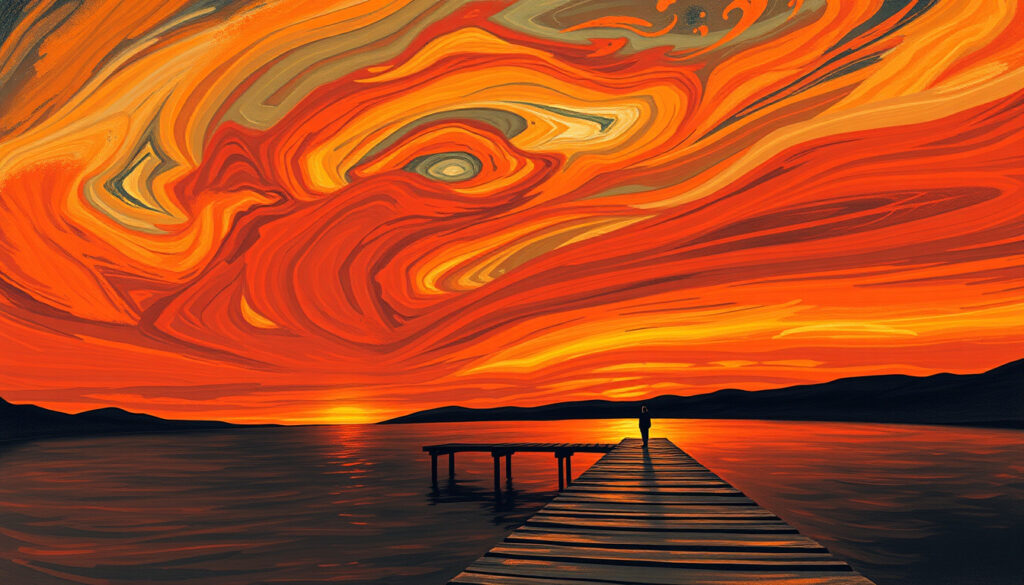
Edvard Munch – Biography, The Scream, Paintings and Style
Edvard Munch, a Norwegian painter and printmaker, occupies a singular place in modern art. He created a body of work that bridges late 19th-century Symbolism and the explosive energy of early Expressionism. His most famous image, The Scream, has transcended the art world to become a global shorthand for anxiety and existential dread. Munch’s art was deeply personal, drawing on his own experiences of illness, loss, and love to create visual representations of universal human emotions.
Munch was born on 12 December 1863 in Løten, Norway, and died on 23 January 1944 near Oslo. His career spanned over six decades, during which he constantly experimented with painting, graphic art, drawing, sculpture, and even photography. The Munch Museum in Oslo now holds the largest collection of his work, describing him as one of modernism’s most significant artists.
What set Munch apart was his commitment to depicting inner psychological reality rather than outward appearances. He transformed personal memory, emotion, and trauma into recurring visual themes, making him a pioneer of the expressionist movement that would dominate European art in the early 20th century.
Who Was Edvard Munch? Biography and Background
Key Insights About Edvard Munch
- Munch’s work is often categorized as Expressionist, though he was also influenced by Symbolism and Post-Impressionism.
- The Scream exists in four versions: two paintings, two pastels, and a lithograph; the most famous is the 1893 tempera and crayon version.
- Munch’s art explores universal themes of anxiety, love, death, and existential dread, drawn from his personal tragedies.
- He was a pioneer of Modernism and used unconventional techniques such as rough brushstrokes, vivid non-naturalistic colors, and woodcut prints.
- Munch’s legacy endures in popular culture; The Scream is one of the most parodied and referenced artworks in history.
Key Facts About Edvard Munch
| Category | Detail |
|---|---|
| Full Name | Edvard Munch |
| Nationality | Norwegian |
| Birth | 12 December 1863, Ådalsbruk, Norway |
| Death | 23 January 1944, Oslo, Norway |
| Movements | Expressionism, Symbolism, Modernism |
| Notable Works | The Scream (1893), The Kiss (1897), The Sun (1910–1911), Madonna (1894) |
| Mediums | Oil paint, pastel, tempera, lithography, woodcut, photography |
| Museum | Munch Museum, Oslo, Norway (major collection) |
What Is Edvard Munch Best Known For? The Scream and Its Meaning
Munch’s reputation rests heavily on The Scream (1893), a painting that Britannica describes as a symbol of modern spiritual anguish. The Munch Museum and other sources present it as one of the most iconic images in world art. The figure at the center, with his hands pressed to his ears and mouth open in a silent cry, has become a universal emblem of anxiety, fear, and existential distress.
Munch placed The Scream within the larger series The Frieze of Life, where he explored life, love, fear, death, and melancholy. This context matters: the painting is not just a standalone image but part of a broader symbolic cycle about human existence. Commonly supported themes in the sources include anxiety, fear, existential distress, modern alienation, and psychological crisis.
Munch described the inspiration for The Scream in his diary. He wrote of walking with friends at sunset when the sky turned blood red. He paused, feeling exhausted, and sensed “an infinite scream passing through nature.” This personal account ties the painting directly to his own psychological state.
What Are Edvard Munch’s Most Famous Paintings?
Beyond The Scream, Munch produced a wide range of iconic works that explore similar emotional and psychological themes. These paintings are often grouped into series, especially The Frieze of Life, which he worked on for decades.
The Kiss (1897)
The Kiss depicts a couple embracing, their faces merging into a single, almost abstract form. The painting is part of the Frieze of Life series and explores themes of intimacy, union, and the dissolution of individual identity in love. Munch created multiple versions of this subject, including paintings and prints.
The Sun (1910–1911)
The Sun is a large mural painted for the University of Oslo’s Assembly Hall. Unlike the dark, anxious tone of The Scream, this work is a radiant, optimistic depiction of sunlight streaming over a landscape. It shows Munch’s range, moving from psychological turmoil to a celebration of nature and life. The Munch Museum holds several studies for this work.
While the themes of The Kiss and The Sun are widely discussed, art historians note that no single conclusive interpretation exists for either work. Munch’s art is deliberately open to multiple readings, reflecting his complex personal symbolism.
What Artistic Style Did Edvard Munch Use?
Munch’s art is usually described as psychological, symbolic, and emotion-driven rather than observational. His style is identified by bold, expressive line, flattened or simplified forms, non-naturalistic color, distortion and exaggeration, and atmospheric intensity. Britannica states that his work built on late 19th-century Symbolism and had a major influence on German Expressionism.
Techniques and Mediums
Munch’s technique is strongly tied to emotional effect rather than realism. He used color symbolically, not naturalistically, and relied on simplified, schematic forms with expressive distortion. He was not only a painter but a major printmaker and graphic artist. His prints helped spread his imagery and further developed his use of line, contrast, and simplified forms. The San Francisco Museum of Modern Art notes his importance in woodcuts and his expressive treatment of emotions and personal relationships.
Are There Books About Edvard Munch?
The search results do not provide a full bibliography of Munch’s own writings, but they show that he is frequently studied through biographies, catalogues, and museum publications. The most authoritative sources identified are the museum and reference-encyclopedia entries. Popular titles include Edvard Munch: The Frieze of Life (his own writings), Edvard Munch: Behind the Scream by Sue Prideaux, and Edvard Munch: The Modern Eye by Angela Lampe and others. For further exploration, visitors to this article can also consult the Edvard Munch research overview provided by Britannica.
Edvard Munch: Life and Career Timeline
- 1863: Born in Ådalsbruk, Norway, to Christian Munch and Laura Cathrine Bjølstad.
- 1879: Enrolls at the Royal School of Art and Design in Oslo.
- 1885: Travels to Paris and studies under Léon Bonnat; influenced by Impressionism.
- 1893: Creates The Scream, initially titled “Despair.”
- 1897: Paints The Kiss, part of the Frieze of Life series.
- 1908–1909: Suffers a nervous breakdown; undergoes treatment in Copenhagen.
- 1910–1911: Completes The Sun mural for the University of Oslo’s Assembly Hall.
- 1937: Nazi regime declares Munch’s art “degenerate”; 82 works confiscated from German museums.
- 1944: Dies at age 80 in Oslo; bequeaths his estate to the city, forming the basis of the Munch Museum.
Certainty vs. Uncertainty in Munch’s Life and Works
| Aspect | Established Information | Information That Remains Unclear |
|---|---|---|
| Birthplace and Date | Confirmed – 12 December 1863 in Ådalsbruk, Norway. Documented in parish records. | None. |
| Number of Versions of The Scream | Confirmed – four versions (two paintings, two pastels, one lithograph). The tempera version (1893) is the most famous. | None. One pastel sold for nearly $120 million in 2012. |
| Interpretation of The Scream | Munch described the inspiration as a feeling of anxiety. | No single conclusive interpretation exists; multiple scholarly readings debate whether it is about modern alienation, a personal panic attack, or a response to nature. |
| Ownership of The Scream | One painting at National Gallery, Oslo; other versions at Munch Museum and private collections. | None. A 2004 theft of one version was resolved in 2006; ownership records are clear. |
| Cause of Death | Confirmed – natural causes (pneumonia) at age 80. Medical records from Oslo. | None. |
Analysis and Artistic Context
Munch’s works such as The Scream and The Kiss explore deep psychological states – anxiety, intimacy, mortality – often rooted in his own family losses. His mother died of tuberculosis and his sister suffered mental illness, events that left a lasting imprint on his art. Munch used exaggerated colors and distorted forms to convey emotion, predating and influencing German Expressionism through groups like Die Brücke and Der Blaue Reiter.
His experimental printmaking and rejection of naturalism paved the way for later Modernist movements including Abstract Expressionism and Neo-Expressionism. The Munch Museum presents him as a central modern artist whose experimentation extended across multiple media and whose work belongs to both Symbolism and early Expressionism. This framing aligns with Britannica, which stresses his role in moving art from external depiction toward internal psychological expression.
Key Sources and Quotations
“I was walking along the road with two friends – the sun was setting – suddenly the sky turned blood red – I paused, feeling exhausted, and leaned on the fence – there was blood and tongues of fire above the blue-black fjord and the city – my friends walked on, and I stood there trembling with anxiety – and I sensed an infinite scream passing through nature.”
Edvard Munch, describing the inspiration for The Scream (from his diary, 1892)
The Munch Museum (Oslo) is the official repository of Munch’s works and archives. Other authoritative sources include Wikipedia – Edvard Munch and the Tate – Edvard Munch page. Munch’s own writings, including The Frieze of Life, provide personal insight into his artistic vision. For those interested in his print work, The Met’s essay on Munch’s prints offers a focused analysis.
Exploring Munch’s Enduring Legacy
Edvard Munch’s influence continues to be felt across art, popular culture, and visual media. His ability to condense complex emotional states into powerful, simplified images is why his work remains relevant. The Scream, in particular, has become a global icon, referenced in film, memes, and merchandise. To see his original works, the Munch Museum in Oslo houses the largest collection, while the National Gallery in Oslo, the Tate in London, and the Art Institute of Chicago also hold major pieces. For a deeper understanding of his stylistic innovations, readers can explore Edvard Munch’s Symbolism and Expressionism through expert analysis.
Frequently Asked Questions
How do you pronounce Edvard Munch?
In Norwegian, it is pronounced roughly ‘ED-vard MOONK’. The ‘d’ is soft, and ‘Munch’ rhymes with ‘junk’. The English approximation is ‘ED-vard Munk’.
What is Edvard Munch’s most famous painting?
The Scream (1893) is by far his most iconic work, recognized globally as a symbol of anxiety.
How many versions of The Scream did Munch create?
Munch produced four versions: two paintings (tempera and oil/casein), two pastels, and a lithograph.
What does The Scream symbolize?
It is widely interpreted as representing existential anxiety and the human response to the overwhelming power of nature. Munch described it as “the infinite scream passing through nature.”
Where can I see Edvard Munch’s paintings?
The largest collection is at the Munch Museum in Oslo, Norway. Other major works are at the National Gallery (Oslo), the Tate (London), and the Art Institute of Chicago.
Did Edvard Munch have any famous students?
He did not have formal students, but his work had a profound influence on German Expressionist artists such as Ernst Ludwig Kirchner and Erich Heckel.
What books about Edvard Munch are recommended?
Popular titles include Edvard Munch: The Frieze of Life by Edvard Munch, Edvard Munch: Behind the Scream by Sue Prideaux, and Edvard Munch: The Modern Eye by Angela Lampe and others.
More related posts
 Sky Customer Service Number 0800 – Official UK Contact Lines
 Can Anyone Do a Bro Split – Suitability Pros Cons Alternatives
 Justin Trudeau – Current Status, Net Worth, Family in 2025
 Floyd Mayweather – Record, Net Worth, Next Fight and Career
 Tanya Roberts – Cause of Death and Hollywood Legacy
 Louise Bourgeois – Life, Spiders, Maman and Techniques
 Tomato and Basil Soup – Easy Recipes and Chef Tips
 Julian Sands – Cause of Death, Disappearance and Full Filmography