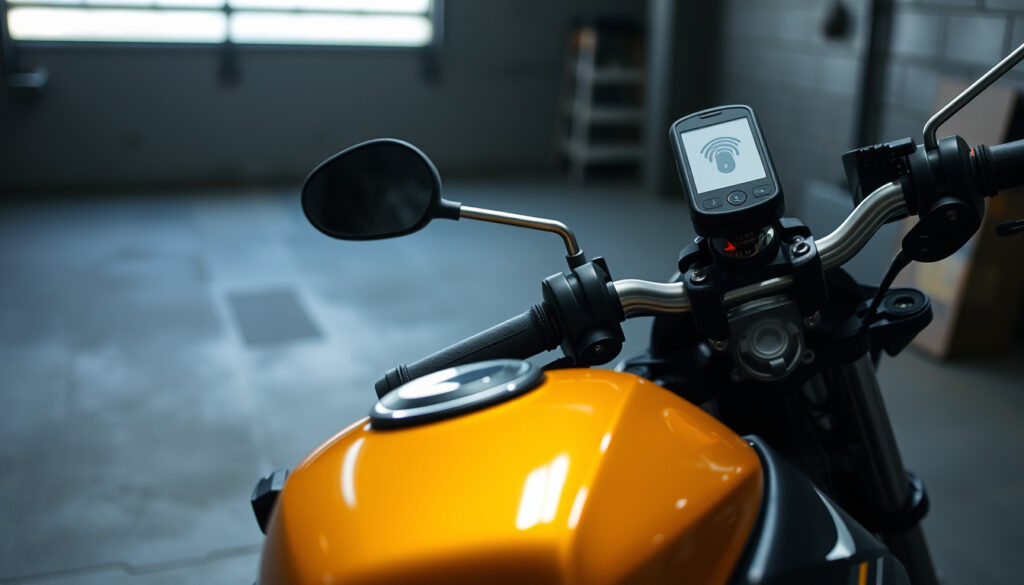
Desmond Tutu – Motorcycle Immobilizer Security No Longer Enough
Motorcycle theft has evolved far beyond simple hot-wiring. Today, criminals are bypassing factory immobilizers with cheap electronics and clever exploits, leaving owners who rely solely on built-in security with little protection. Understanding the latest theft methods is the first step toward safeguarding your bike.
How do thieves bypass modern motorcycle immobilizers?
Boards costing as little as £5 are plugged into wiring looms to imitate the key-authentication handshake.
Attackers capture a single seed/key exchange and recreate the vehicle-specific immobilizer secret offline.
Cables behind the ignition are cut, and bridge connections are soldered to simulate the correct signal.
Some methods, like the authentication bypass identified as CVE-2026-49323, do not require firmware changes and leave no damage.
- Bypass devices are widely available online and cost minimal amounts.
- Many immobilizers sit under removable covers, providing thieves with easy physical access.
- Weak authentication protocols (classified as CWE-327) allow secret reconstruction from a single captured exchange.
- In one documented case, a Yamaha MT-09 was started by cutting wires and plugging in a simple board with two switches, bypassing a Thatcham-approved system.
- The exploit does not require code execution or advanced programming skills.
- Online marketplaces like eBay have sold these bypass tools, though some listings have been taken down after reporting.
| Method | Tool Cost | Skill Level | Physical Access Required | Visibility |
|---|---|---|---|---|
| Circuit board loop | £5 | Low | Wiring loom | Remains plugged in |
| Authentication secret reconstruction | Sniffer device (variable) | Medium | Adjacent to network bus | No trace |
| Physical wiring manipulation | Tools only | Low | Behind ignition or under cowl | Cut wires, soldered bridges |
| Steering lock snapping | Tool only | Low | Lock mechanism | Broken lock |
| ECM spoofing via diagnostic port | Sniffer + software | Medium | Physical to OBD port | No trace if patched |
| Relay attack on passive keyless | Amplifier kit | Low | Within 10–15m of key | No physical trace |
Which motorcycles are most vulnerable to immobilizer bypass attacks?
Yamaha MT-09 and MTU range
The Yamaha MT-09 and the broader MTU lineup are frequently targeted. Owners have reported that factory immobilizers provide little real protection, making these popular bikes especially attractive to thieves. In one case, a board with two switches was used to start a stolen MT-09 after cutting wires behind the ignition.
Indian Motorcycle Scout Bobber (2025)
A specific vulnerability, catalogued as CVE-2026-49323, affects the 2025 model of the Indian Motorcycle Scout Bobber. The flaw lies in the Wireless Control Module (WCM) and Engine Control Module (ECM). An attacker with physical or adjacent access to the in-vehicle network bus can use a passive sniffer to capture a single seed/key exchange, then reconstruct the per-vehicle ECM immobilizer secret offline. This allows them to inject a forged authentication, bypass the WCM, and start the engine without modifying any firmware and leaving no visible trace. SentinelOne documented this vulnerability in detail.
Meta 357 aftermarket system
Even aftermarket immobilizers are not immune. The Meta 357 system has been demonstrated in tutorial videos on YouTube as easily bypassed using similar low-cost techniques.
The authentication bypass for the Indian Motorcycle Scout Bobber (CVE-2026-49323) does not require code execution. Because the attack reproduces the immobilizer secret from a single sniffed exchange, it can be carried out quickly and leaves no evidence on the motorcycle.
What factors make modern immobilizers so easy to defeat?
Low cost of tools
Bypass devices are available online for minimal outlay. Circuit boards that mimic the key authentication handshake can be purchased for as little as £5, making the barrier to entry extremely low.
Ease of physical access
Many immobilizers are located under removable plastic covers, near the steering head or under the seat. Thieves can expose the wiring loom in seconds and then cut or tap into the required circuits.
Weak encryption and authentication
Some systems rely on authentication protocols that fall under the weakness classification CWE-327, meaning the secret can be reconstructed from a single captured exchange. The absence of strong encryption or rolling codes makes sniffing attacks viable.
Online marketplace availability
Bypass tools have been sold openly on platforms such as eBay. While some listings have been removed after reporting, the availability of these devices remains a problem.
The same techniques used against factory immobilizers are also applied to aftermarket systems like Meta 357. Thieves are not discriminating between OEM and add-on electronics – any immobilizer that relies on a predictable authentication handshake is at risk.
How have immobilizer bypass techniques evolved over time?
- Early 2000s: Hot-wiring by connecting ignition wires directly. Immobilizers became widespread, forcing thieves to find new methods.
- Mid-2010s: Relay attacks on passive keyless entry systems allowed thieves to amplify the signal from a key inside a house to start a car or bike without the physical key.
- ~2018: First documented use of low-cost circuit board loops on motorcycles. A Yamaha MT-09 was stolen using a board plugged into the wiring loom.
- 2024–2025: Authentication secret reconstruction emerges. The vulnerability CVE-2026-49323 demonstrates that a single sniffed seed/key exchange can be decoded offline to regenerate the immobilizer secret.
- 2025 onward: Attack methods continue to grow in sophistication. Tools become cheaper and more accessible via online marketplaces, while many manufacturers have not yet deployed effective firmware patches.
What is certain and what remains unclear about immobilizer security?
| Established information | Information that remains unclear |
|---|---|
| Circuit board loops can bypass many Thatcham-approved immobilizers. | How many motorcycle models share the same vulnerable authentication design. |
| CVE-2026-49323 affects the 2025 Indian Motorcycle Scout Bobber. | Whether firmware patches exist for this vulnerability and if they are effective across all model variants. |
| Bypass devices are sold on eBay and other marketplaces. | The full extent of sales and how many bikes have been stolen using these tools. |
| Physical manipulation of wiring looms is a common method. | Which additional models have immobilizers accessible enough for these attacks to succeed without expert knowledge. |
What does the rise in immobilizer bypass methods mean for motorcycle owners?
Factory immobilizers were originally a breakthrough in anti-theft technology, but the arms race has tilted in favour of criminals. The combination of low-cost bypass tools, weak authentication protocols, and easy physical access means that a motorcycle equipped only with a factory immobilizer is no longer well protected. Thieves are adapting faster than many manufacturers are updating their systems. For riders, this means that the convenience of a built-in immobilizer is not enough – additional protective layers are essential. A layered security approach is no longer optional; it is a necessity.
Where do the experts provide evidence of these bypass techniques?
Documentation comes from several sources. Bennetts BikeSocial, a UK motorcycle insurance specialist, reported on the Yamaha MT-09 case and the availability of £5 bypass boards. SentinelOne published the technical details of CVE-2026-49323, describing the passive sniffing and secret reconstruction method. Tutorial videos on YouTube demonstrate the Meta 357 bypass and physical wire-cutting techniques. The Motorcycle Safety Foundation offers general theft prevention advice that aligns with the need for layered security.
“The attacker with physical or adjacent access to the in-vehicle network bus uses a passive sniffer to capture a single seed/key exchange. The attacker then reconstructs the per-vehicle ECM immobilizer secret offline.”
— SentinelOne vulnerability database, CVE-2026-49323
“A stolen Yamaha MT-09 was started by cutting wires behind the ignition, plugging in a board with two switches, and activating them to bypass a Thatcham-approved system.”
— Bennetts BikeSocial
“Factory immobilizers are no longer reliable as a standalone defense.”
— Motorcycle security analysis
What should riders take away from this?
Layered security is no longer optional. Relying solely on a factory immobilizer exposes a motorcycle to theft via cheap, accessible tools. Combining physical locks, GPS tracking, aftermarket kill switches, tamper-evident seals, and recovery services dramatically raises the effort required for a thief to succeed.
Frequently asked questions
Can a £5 circuit board really start any motorcycle?
It can start motorcycles that use a simple authentication handshake between the key and immobilizer receiver. Not all models are equally vulnerable, but many modern bikes are affected.
Is the Indian Motorcycle Scout Bobber recall affected?
Indian Motorcycle may issue a firmware update. Owners should contact an authorized dealer to check for patches addressing CVE-2026-49323.
Do steering locks help?
Yes. Engaging the steering lock when parked adds a physical barrier, though it can be snapped. It is one element of a layered approach.
Are aftermarket immobilizers better than factory ones?
Not necessarily. The Meta 357 system has been bypassed with similar techniques. A supplemental immobilizer that interrupts a circuit not governed by the ECM authentication flow adds genuine protection.
Will a GPS tracker stop theft?
It will not prevent theft but greatly increases the chance of recovery. Many riders use trackers alongside physical locks and kill switches.
What is a tamper-evident seal?
A sticker or plastic seal placed over diagnostic connectors and access panels. If broken, it shows that someone has accessed those areas.
How can I tell if my bike’s immobilizer is weak?
Check with your dealer about known vulnerabilities. Consider supplementing with a disc lock, chain, or an aftermarket kill switch regardless of the immobilizer rating.
Is it safe to park a motorcycle in the street?
Parking in a street increases risk. Using a cover, locking to a ground anchor, and fitting a GPS tracker can help, but no single measure guarantees safety.
Do motorcycle covers really deter thieves?
Yes. A cover hides the make and model and adds time to access the bike, deterring opportunistic thieves who want a quick steal.
What is the most effective single anti-theft device?
No single device is perfect. Experts recommend using multiple devices from different categories – physical locks, electronic immobilizers, and tracking – to create layers of defense.
More related posts
 Mama Cass – The True Story Behind the Ham Sandwich Myth
 Mike Wozniak – Biography, Career, and Personal Life
 Charity Dingle – Age, Family, Children and 2025 Storyline
 Michelle Ackerley – BBC Presenter, Career, Hair and Husband Ben Ryan
 Man Shoes – Best UK Formal, Casual & Trainers Guide 2025
 Tom Selleck – Net Worth, Height, Movies & TV Shows in 2025
 Think and Grow Rich – Summary and 13 Principles
 Untamed Miniseries Reviews – Complete Ratings Breakdown